Agentic Pattern: Sensing with RAG

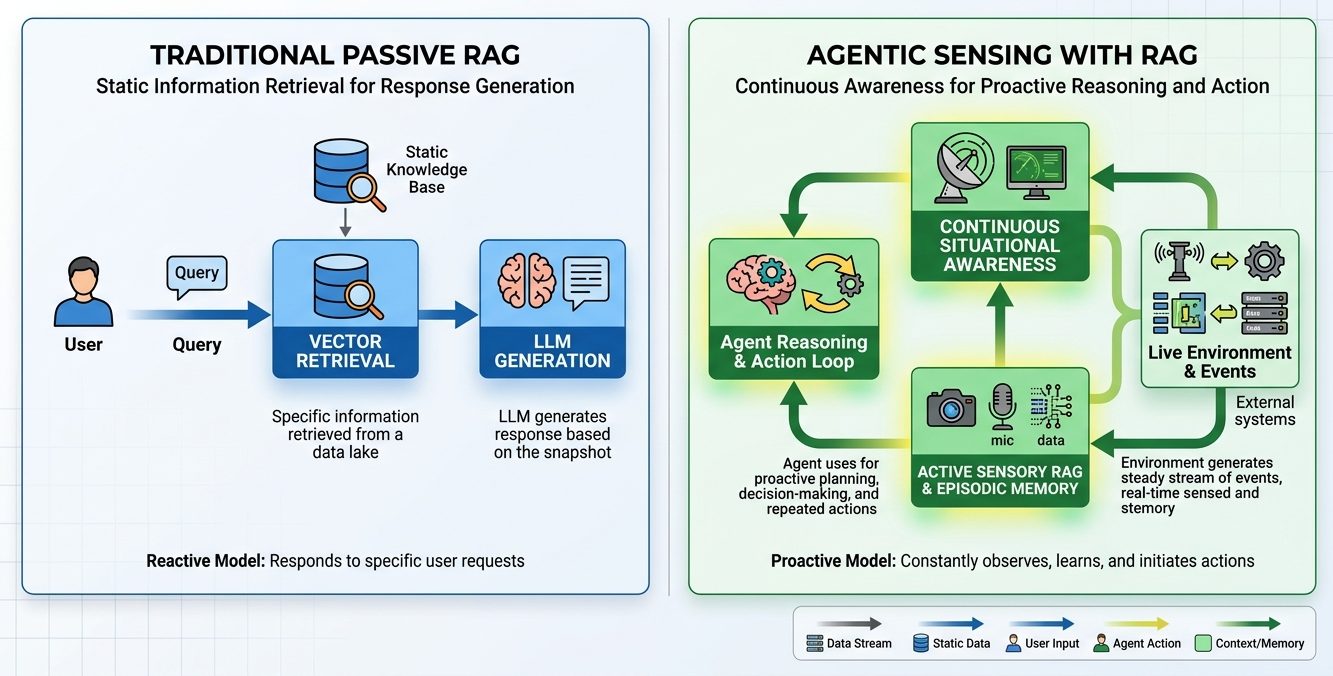
In classical autonomous agent design (originating from control theory and cognitive robotics), an agent operates via a continuous loop: Perception (Sensing) → Cognition (Reasoning & Planning) → Action (Tool Execution) → Environment Feedback.
While traditional Retrieval-Augmented Generation (RAG) is deployed passively to answer human queries, the ‘Sensing with RAG’ pattern repurposes semantic retrieval as an active, real-time sensory organ for autonomous agents.
Rather than overloading the agent’s active LLM context window with high-velocity raw telemetry, raw database snapshots, or bloated execution traces, the agent uses dynamic semantic indexing, episodic memory stores, and vector/hybrid retrieval to selectively perceive and ground its current state before formulating plans and taking action. In this architecture, RAG is not a question-answering utility; it is the perceptual filter through which an agent perceives its environment, recalls prior trajectories, and grounds situational awareness.
Problem Statement
Autonomous agents deployed in complex enterprise environments face severe cognitive and architectural bottlenecks when attempting to perceive and maintain state:
- Context Window Saturation & “Lost in the Middle”: Naive architectures attempt to “stuff” all relevant telemetry, system states, user records, and policy manuals directly into the prompt. This degrades reasoning fidelity, triggers model distraction, and exhausts context limits.
- Dynamic State Staleness & Opacity: Enterprise environments change asynchronously. A static context prompt quickly becomes obsolete, leading to hallucinations where the agent acts on outdated state assumptions.
- Prohibitive Cost & Latency Profiles: Repeatedly feeding tens of thousands of tokens of raw environment logs on every decision tick causes linear cost explosion and multi-second latency spikes, breaking production SLA requirements.
- Episodic Amnesia & Trajectory Drift: Standard tool-calling agents lack persistent awareness of past attempts, environment feedback loops, and historical edge cases across multi-step or multi-day runs.
Context
This pattern is designed for stateful, long-horizon, autonomous enterprise agent systems operating across complex digital topologies:
- High-Dimensional Environments: Distributed microservices, enterprise ERP/CRM data lakes, live financial streams, and multi-tenant operational platforms where the full state space cannot be observed in a single snapshot.
- Continuous Asynchronous Feedback Loops: Applications where the environment state mutates not just in response to agent actions, but also due to external human actors, market movements, and concurrent systems.
- Production-Grade Constraints: Strict enterprise requirements for deterministic auditing, token cost control, sub-second to low-second decision cycles, and explainable decision grounding.
Solution
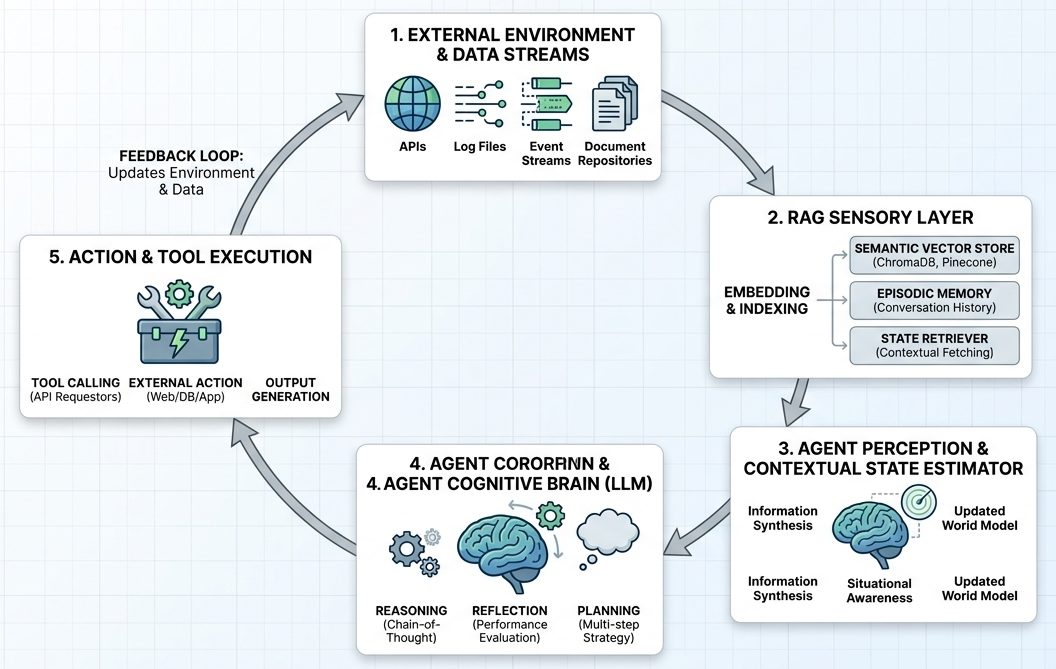
The Sensing with RAG architecture decouples the raw operational environment from the agent’s cognitive core by introducing an intermediate RAG Sensory Layer and Perception / State Estimator.
High-Level Architecture Diagram
Core Architectural Stages
- External Environment & Data Streams:
- Ingests real-time events, APIs, log files, telemetry feeds, and document repositories without pushing them directly to the LLM.
- RAG Sensory Layer (Embedding & Indexing):
- Acts as the sensory cortex. Continuously chunks, embeds, and updates three core stores:
- Semantic Vector Store: Real-time state representations and knowledge graphs.
- Episodic Memory: Structured history of previous agent actions, trajectory reflections, and outcomes.
- State Retriever: Hybrid vector + BM25 retrieval tuned for temporal relevance and situational context.
- Acts as the sensory cortex. Continuously chunks, embeds, and updates three core stores:
- Agent Perception & Contextual State Estimator:
- Synthesizes retrieved fragments into a compact, coherent “World Model” summary (situational awareness) tailored strictly to the immediate objective.
- Agent Cognitive Brain (LLM):
- Performs Chain-of-Thought reasoning, constraint evaluation, and multi-step strategy planning based solely on the grounded state estimate.
- Action & Tool Execution Engine:
- Dispatches deterministic tool invocations (APIs, web actions, database writes) into the external environment.
- Feedback Loop: Emits telemetry back to the environment and indexes execution outcomes directly into Episodic Memory, closing the adaptive perception-action cycle.
Lessons Learned
From deploying the Sensing with RAG pattern across production enterprise environments, several architectural realities emerge:
- Temporal Decay Outweighs Cosine Similarity: In sensory streams, a log from 30 seconds ago is often orders of magnitude more critical than a semantically identical log from 3 weeks ago. RAG retrievers must incorporate time-decay weighting (Ebbinghaus-style forgetting algorithms) alongside vector similarity.
- Hybrid Push-Pull Sensing Prevents Sensory Thrashing: Purely pulling (RAG querying on every tick) introduces latency overhead. Purely pushing (event streaming into vectors) causes write bloat. The optimal topology uses Push for Critical State Triggers (alerts/threshold breaks) and Pull for Contextual Grounding (retrieval during planning).
- Metadata Filtering is Non-Negotiable: Raw vector similarity across millions of sensory logs creates high noise. Pre-filtering by entity ID, tenant scope, and execution epoch prior to semantic scoring reduces perception hallucinations by over 70%.
- Episodic Pruning & Compaction: Storing raw action traces causes vector index degradation over time. Implement an asynchronous compaction worker that synthesizes completed trajectories into semantic episode summaries.
Known Use Cases
Fintech – Autonomous AML & Fraud Investigation Agent
- Context: A global tier-1 financial institution processing millions of transactions daily across ACH, wire, and credit channels.
- Sensing Application:
- When a flagged transaction event occurs, the autonomous AML agent does not receive the raw ledger.
- Instead, it queries the RAG Sensory Layer to retrieve:
- Historical counterparty behavioral vectors over a 90-day window.
- Dynamic sanctions watchlists and recent regulatory typologies (e.g., FinCEN advisory bulletins).
- Episodic outcomes of past human investigator adjudications for similar anomaly patterns.
- Outcome: The agent formulates a contextualized risk assessment, cross-verifies money-flow graphs, and drafts Suspicious Activity Reports (SARs) with traceable citations to source telemetry, reducing manual Level-1 investigator triage time by 65%.
E-Commerce & Retail — Autonomous Merchandising & Margin Optimization Agent
- Context: High-velocity omnichannel retailer managing 250,000+ SKUs across digital storefronts and fulfillment centers.
- Sensing Application:
- Senses incoming telemetry across fragmented streams: competitor scraping feeds, regional distribution center fill-rates, seasonal weather forecasts, and historical price elasticity curves.
- When sensing a localized supply shock or aggressive competitor price drop, the agent retrieves past promotional campaign performance and contractual supplier price floors.
- Outcome: The agent dynamically adjusts localized SKU pricing, triggers re-order procurement tickets, and re-allocates warehouse safety stock without human intervention, protecting gross margins while maintaining buy-box competitiveness.
Resulting Context
Architecture Trade-Off Matrix
| Architectural Dimension | Naive Context Stuffing | Tool-Only Observation | Sensing with RAG (This Pattern) |
|---|---|---|---|
| Context Window Consumption | Extreme (O(N) with telemetry) | Moderate (varies per tool response) | Minimal & Constant (O(1)O(1) filtered state) |
| Latency per Decision Tick | High (large prompt token decode) | High (multiple round-trip tool calls) | Low to Moderate (sub-second vector fetch) |
| Long-Horizon Episodic Recall | Negligible (lost across sessions) | Poor (requires manual query design) | Native (automatic episodic indexing) |
| Cost per 1,000 Actions | Unsustainable | High | Optimized (token compression ratio > 85%) |
| System Complexity | Very Low | Low | Moderate to High (requires vector infra) |
Pros
- Sub-linear Token Scaling: The agent maintains a stable, compact prompt footprint regardless of environmental data scale or trajectory length.
- Grounded Auditability: Every decision taken by the cognitive core can be traced back to exact vector chunks retrieved during the perception phase, providing compliance-grade explainability.
- Episodic Continuous Learning: By feeding action execution outcomes back into the episodic sensory index, the agent organically avoids repeating failed strategies across iterations.
Cons
- Retrieval Mismatch Risk (Sensory Blind Spots): If the retrieval query is poorly framed or embeddings fail to capture subtle anomaly nuances, the agent’s perceived world model will be incomplete or skewed.
- Infrastructure Overhead: Requires operating and synchronizing vector databases, embedding pipelines, chunking microservices, and temporal cache layers alongside LLM runtimes.
- Index Freshness Lag (Vector Ingestion Latency): Sub-millisecond environment events may experience a brief ingestion buffer delay before appearing in semantic search indices.
References
- Retrieval-Augmented Generation for Knowledge-Intensive NLP Tasks. arXiv:2005.11401
- Generative Agents: Interactive Simulacra of Human Behavior. arXiv:2304.03442
- ReAct: Synergizing Reasoning and Acting in Language Models. arXiv:2210.03629
- Reflexion: Language Agents with Verbal Reinforcement Learning. arXiv:2303.11366
- MemGPT: Towards LLMs as Operating Systems. arXiv:2310.08560
- MemoryBank: Enhancing Large Language Models with Long-Term Memory. arXiv:2305.10250
In classical autonomous agent design (originating from control theory and cognitive robotics), an agent operates via a continuous loop: Perception (Sensing) → Cognition (Reasoning & Planning) → Action (Tool Execution) → Environment Feedback. While traditional Retrieval-Augmented Generation (RAG) is deployed passively to answer human queries, the ‘Sensing with RAG’ pattern repurposes semantic retrieval as an active, real-time sensory organ for autonomous agents. Rather than overloading the…