Agentic Pattern: Agent-Specific Context and Memory

In enterprise multi-agent systems (MAS), treating context and memory as a single monolithic conversation buffer quickly breaks down. The Agent-Specific Context and Memory pattern decouples and scopes memory hierarchies – ephemeral working scratchpads, session state, and persistent episodic/semantic stores – to individual, specialized autonomous agents.
Rather than maintaining an ever-growing global blackboard or concatenated dialogue transcript, each agent is provisioned with its own bounded context window, domain-specific memory namespaces, and isolated retrieval mechanisms. This guarantees that every agent operates with high cognitive clarity, strict operational boundaries, and deterministic efficiency within complex collaborative topologies.
Problem Statement
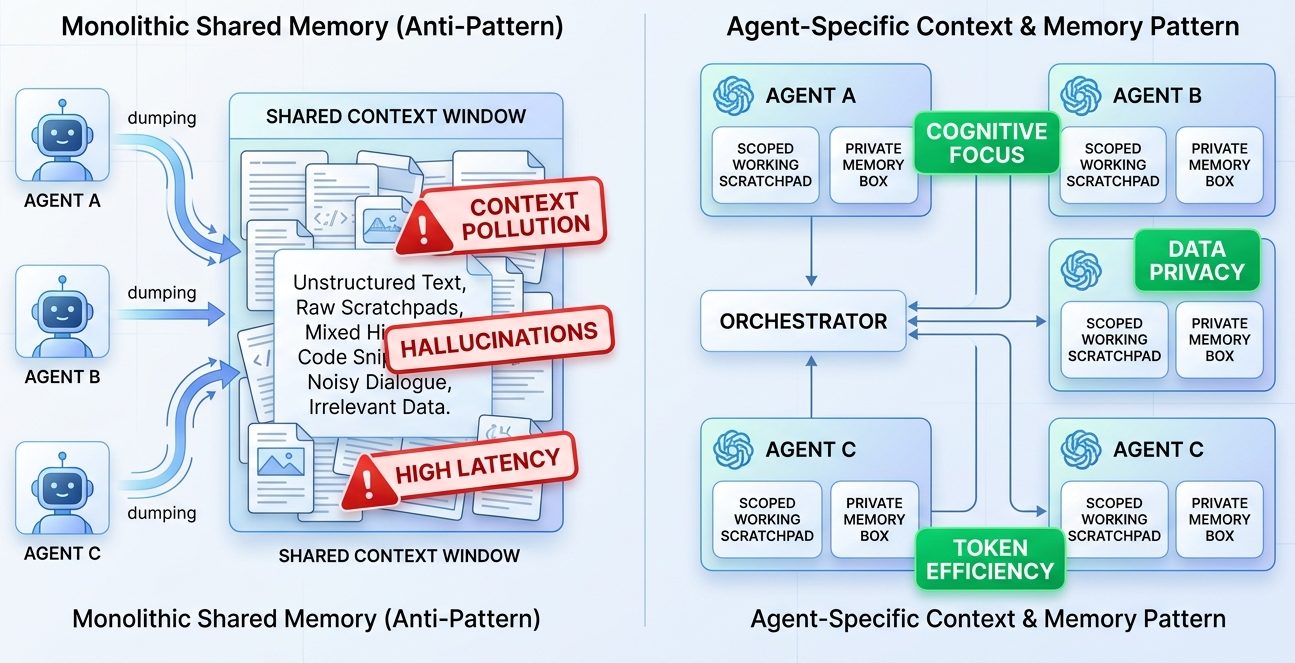
Architecting autonomous agents using a single shared context window or unified memory pool introduces critical systemic failures at enterprise scale:
- Context Window Degradation (“Lost in the Middle”): As conversation histories expand with multi-step tool invocations and cross-agent chatter, foundation models suffer from attention dispersion and recall degradation (arXive 2307.03172).
- Context Contamination & Role Bleed: Intermediate scratchpad observations from one agent (e.g., raw SQL schemas, speculative heuristics, or parsing failures) contaminate the prompt space of peer agents. This triggers identity drift, hallucinated constraints, and reasoning interference.
- Runaway Latency & Token Economics: Forwarding cumulative multi-agent dialogue history on every turn results in quadratic token scaling ( in naive conversational loops) and unacceptable Time-to-First-Token (TTFT).
- Security & Least-Privilege Violations: Monolithic contexts inadvertently expose sensitive customer PII, regulatory flags, or internal tool secrets to non-authorized agents operating within the same workflow.
Context
As enterprise architectures transition from monolithic single-agent loops to specialized micro-agent swarms (such as Orchestrator-Worker, Hierarchical Supervisor, or Choreographed pipelines), agents transition from generalists to domain specialists. In these environments:
- Each agent possesses a distinct cognitive responsibility (e.g., policy checking, semantic search, transaction verification).
- Agent lifecycles diverge: some agents are short-lived task executors, while others maintain persistent relationships with user personas or domain entities.
- Enterprise memory operates across three distinct temporal tiers:
- Working Memory: In-context active KV cache, scratchpads, and immediate tool call input/output schemas.
- Short-Term Memory: Transient session state and task checkpointing (e.g., low-latency key-value stores).
- Long-Term Memory: Persistent episodic, semantic, and procedural knowledge (e.g., isolated Vector collections, Knowledge Graphs).
Without explicit agent-level scoping, these memory tiers either collapse into an unmanageable shared prompt or create state-synchronization bottlenecks across concurrent agent workers.
Solution
The Agent-Specific Context and Memory pattern addresses this by isolating context and state at the agent boundary. Agents communicate strictly through minimal, structured contracts (inputs/outputs) mediated by an Orchestrator or event broker, while retaining private working scratchpads and dedicated long-term episodic/semantic stores.
High-Level Architectural Diagram
Architectural Building Blocks
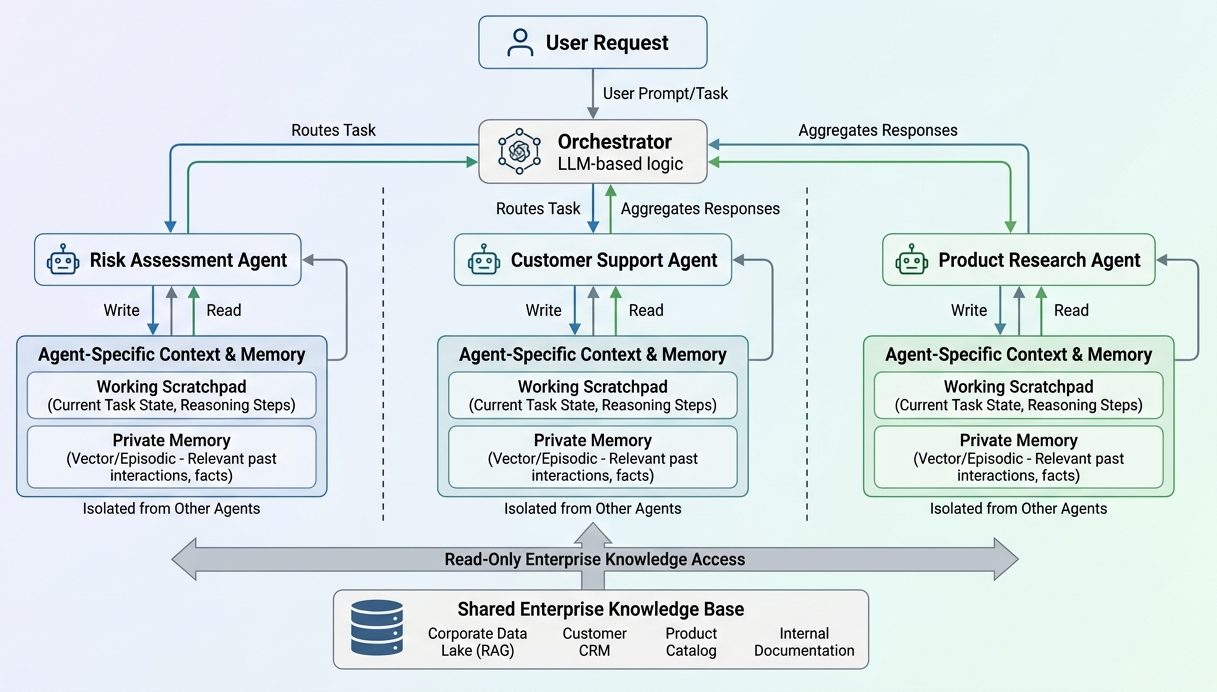
- Orchestration Layer:
- Receives incoming user intents and decomposes them into discrete sub-goals.
- Routes only the minimal required payload (sanitized context, task specification) to each specialized agent.
- Aggregates the final responses without propagating internal agent scratchpads across boundaries.
- Specialized Micro-Agents:
- Autonomous domain workers (e.g., Risk Assessment, Customer Support, Product Research) executing bounded toolsets and role-specific system prompts.
- Isolated Agent-Specific Context & Memory (Per Agent):
- Working Scratchpad (Ephemeral In-Context): The agent’s private reasoning steps (ReAct loops, intermediate tool responses, plan revisions). Never exposed to sibling agents.
- Private Memory Store (Episodic & Semantic): Namespaced vector and relational stores holding agent-relevant history (e.g., historical risk patterns for the Risk Agent; past conversational rapport for the Support Agent).
- Shared Enterprise Knowledge Base (Read-Only Common Ground):
- Centralized corporate knowledge (RAG repositories, CRM, product catalogs, data lakes) accessible by all agents through governed, read-only interfaces.
Lessons Learned
From deploying multi-agent architectures in high-throughput enterprise environments:
- Pass Contracts, Not Transcripts: Agents should exchange strongly typed data transfer objects (e.g., Pydantic or JSON schemas) containing final outputs, never raw conversational transcripts or scratchpads.
- Episodic Memory Requires Garbage Collection: Unpruned vector memory stores accumulate noise and stale observations. Implement reflection and decay mechanisms to consolidate episodic memory into semantic summaries periodically.
- Context Budgeting per Agent Tier: Allocate context token budgets deliberately. An orchestrator requires a lean, routing-focused context; a deep-research agent requires high scratchpad capacity but strict post-execution pruning.
- Traceability Demands Namespaced Observability: Debugging distributed agent failures requires tagging OpenTelemetry / OpenInference spans with specific
agent_idandmemory_namespace_idtags to isolate whether a hallucination originated from corrupted memory retrieval or poor reasoning.
Known Use Cases
1. FinTech: Autonomous Fraud Investigation & Credit Underwriting
- Architecture:
- Fraud Detection Agent: Accesses real-time anomaly graphs, blacklisted IPs, and raw transaction logs. Its private memory tracks intermediate suspicious signal clustering and forensics scratchpads.
- Credit Underwriting Agent: Accesses credit bureau APIs, income verifications, and debt-to-income models.
- Compliance & Audit Agent: Verifies Fair Lending policies and regulatory guidelines.
- Memory Isolation Value: The Fraud Agent’s speculative scratchpads (which may contain unverified suspicions or non-admissible heuristic data) are strictly quarantined. The Underwriting Agent receives only a certified, tamper-proof fraud score flag. This prevents regulatory bias, respects Fair Credit Reporting Act (FCRA) audit constraints, and protects customer PII.
2. eCommerce: Omnichannel Personalization & Fulfillment Swarm
- Architecture:
- Personal Stylist & Recommendation Agent: Maintains persistent long-term episodic memory of consumer style preferences, sizing feedback, and brand affinities.
- Logistics & Order Resolution Agent: Maintains ephemeral working memory focused on carrier SLAs, warehouse inventory counts, return tracking numbers, and delivery exceptions.
- Memory Isolation Value: When a customer asks, “Where is my package, and what shoes match my previous order?”, the orchestrator routes each sub-intent independently. The Logistics Agent is not weighed down by the customer’s aesthetic history, and the Stylist Agent does not waste context tokens parsing shipping manifests.
Resulting Context: Trade-Offs (Pros & Cons)
| Dimension | Pros (Architectural Benefits) | Cons (Architectural Trade-Offs) |
|---|---|---|
| Cognitive Focus & Accuracy | Eliminates attention degradation (“Lost in the Middle”) and eliminates cross-agent hallucination contamination. | Risk of Information Siloing: If the orchestrator fails to extract a vital cross-cutting clue, downstream agents may act on incomplete state. |
| Token Economics & Latency | Minimizes token consumption per prompt; improves time-to-first-token (TTFT) by keeping agent contexts short and focused. | Infrastructure cost overhead of provisioning and managing multiple distinct memory namespaces, indexes, and vector stores. |
| Security & Compliance | Enforces Principle of Least Privilege (PoLP); guarantees strict PII and access control boundaries across agent workflows. | Contract design overhead: Schemas and inter-agent serialization layers must be rigorously versioned and maintained. |
| Maintainability & Evolution | Modular design: Individual agents, prompts, toolsets, and memory indexes can be fine-tuned or swapped independently. | Increased orchestration complexity: Debugging multi-agent synchronization and eventual consistency requires sophisticated tracing tools. |
References
- MemGPT: Towards LLMs as Operating Systems. arXiv:2310.08560
- Generative Agents: Interactive Simulacra of Human Behavior. arXiv:2304.03442
- Lost in the Middle: How Language Models Use Long Contexts. arXiv:2307.03172
- Cognitive Architectures for Language Agents (CoALA). arXiv:2309.02427
- ReAct: Synergizing Reasoning and Acting in Language Models. arXiv:2210.03629
In enterprise multi-agent systems (MAS), treating context and memory as a single monolithic conversation buffer quickly breaks down. The Agent-Specific Context and Memory pattern decouples and scopes memory hierarchies – ephemeral working scratchpads, session state, and persistent episodic/semantic stores – to individual, specialized autonomous agents. Rather than maintaining an ever-growing global blackboard or concatenated dialogue transcript, each…