Architectural Trade-offs in Enterprise Real-Time Voice

When architecting conversational AI, the core question isn’t “which model sounds best?”, it’s who manages the conversation runtime and how audio reaches the model.
In real-time voice, you balance three primary patterns:
- Realtime API Direct: Provides the tightest network boundaries and keeps credentials strictly inside your backend compute. However, your team carries the entire operational burden of turn detection, echo cancellation, jitter buffering, and connection recovery.
- Voice Live + BYOM: Offloads speech processing (turn-taking, noise suppression, neural voices) to a managed layer while allowing you to retain full control over your model deployment SKU, Data Zone residency, and Provisioned Throughput (PTU).
- Voice Live + Prompt Agent: Delivers the smallest custom application footprint by offloading File Search, tool execution loops, and tracing to managed services at the cost of using a cascaded (STT –> Chat –> TTS) pipeline with higher latency.
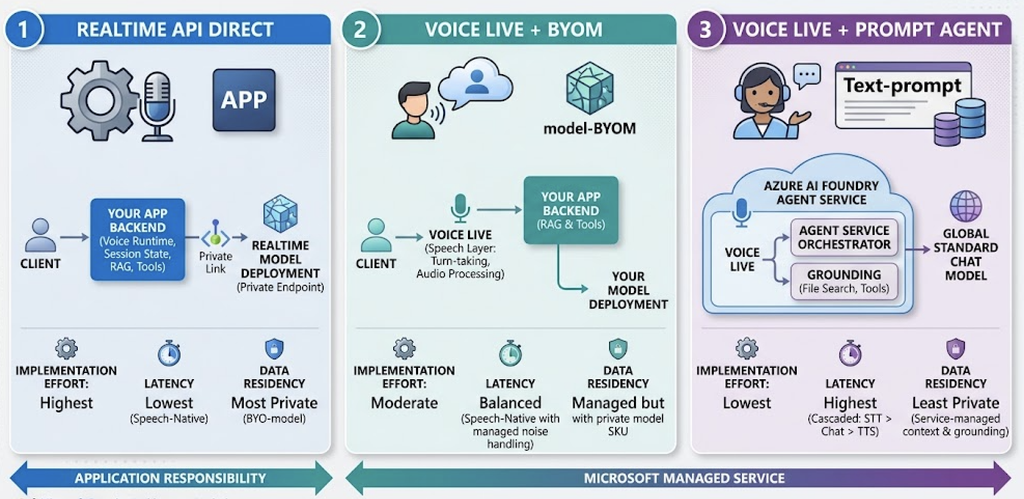
Key Enterprise Gates Before Shipping:
- Latency vs. Orchestration: Speech-native models clock p50 responses near ~400ms, while cascaded reasoning chat agents can stretch past 4 seconds.
- Data Residency: Managed speech, inference, and vector stores frequently route through disparate regions. Never assume model compliance covers the entire voice pipeline.
- Authorization: Voice RAG cannot fail silently; without caller-level security trimming, the model will fluently hallucinate answers out loud.
Reference the full architecture analysis at https://techcommunity.microsoft.com/blog/azure-ai-foundry-blog/choosing-a-real-time-voice-architecture-on-microsoft-foundry-three-enterprise-pa/4552676
When architecting conversational AI, the core question isn’t “which model sounds best?”, it’s who manages the conversation runtime and how audio reaches the model. In real-time voice, you balance three primary patterns: Key Enterprise Gates Before Shipping: Reference the full architecture analysis at https://techcommunity.microsoft.com/blog/azure-ai-foundry-blog/choosing-a-real-time-voice-architecture-on-microsoft-foundry-three-enterprise-pa/4552676