Architectural Paradigm Shift: How Google Cloud’s Low-Code Agents Change Enterprise AI Strategy 🏛️⚡

As a Architect, my core responsibility is aligning long-term technical vision with execution speed, organizational scalability, and rigorous enterprise governance. For years, our default reference architecture has been heavily anchored in the AWS ecosystem. It’s robust, deep, and dependable 🛠️.
However, evaluating Google Cloud’s agentic framework during today’s #BuildWithGemini workshop highlighted a critical shift in how enterprise systems will be architected moving forward.
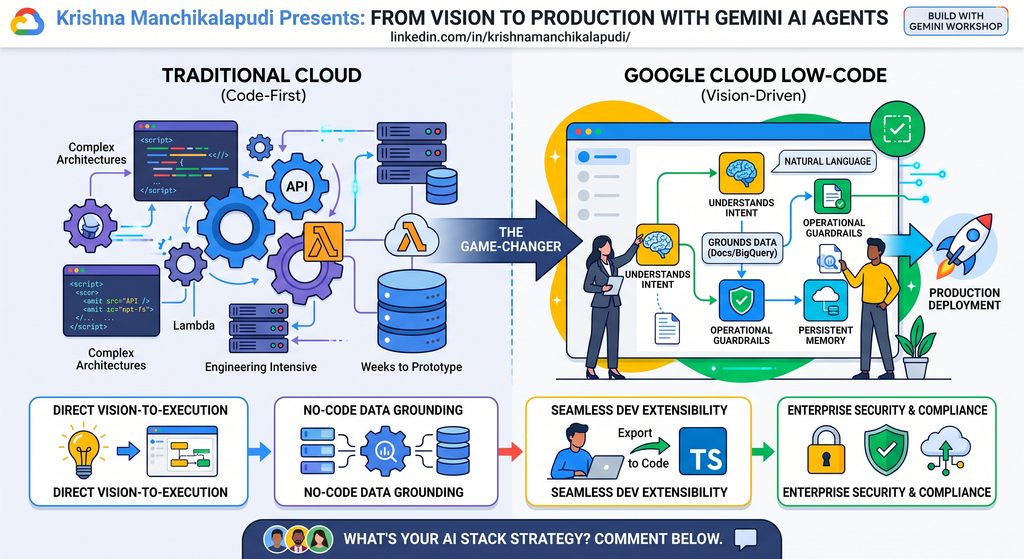
Traditionally, deploying production-grade AI agents requires constructing complex pipeline architectures: orchestrating AWS Lambda functions, provisioning vector search databases, writing custom RAG data ingestion, and managing granular IAM policies. It’s an infrastructure-heavy approach that demands months of engineering cycles before business value is validated ⚙️.
Google Cloud’s Agent Designer and Agent Studio flip this architectural pattern on its head 🔄.
Key strategic takeaways for technical leadership:
- Separation of Business Logic and Infrastructure: Domain experts and product managers can directly author multi-turn agent workflows, operational guardrails, and data-grounding rules in visual low-code interfaces using natural language 🎯.
- Seamless Code-First Extensibility: The platform bridges low-code prototyping with full-stack engineering. Visual schemas export directly into Python or TypeScript, allowing senior developers to attach custom backend API hooks without rewriting the core workflow logic 👨💻.
- Native Governance and Observability: Enterprise requirements like persistent session state (Memory Bank) and real-time safety guardrails (Model Armor) are built into the runtime, satisfying compliance and security audits out of the box 🔒.
The executive takeaway is clear: Enterprise AI development is moving from heavy, write-from-scratch plumbing to composable, high-velocity agent orchestrations 🚀. Reducing time-to-value while preserving structural integrity is how modern technology organizations win.
To my fellow technology executives and principal architects—how are you evolving your reference architectures to balance rapid low-code creation with enterprise-grade stability? 👇
#ChiefArchitect #EnterpriseArchitecture #CloudStrategy #GoogleCloud #BuildWithGemini #AI #LowCode #TechLeadership #SoftwareEngineering
As a Architect, my core responsibility is aligning long-term technical vision with execution speed, organizational scalability, and rigorous enterprise governance. For years, our default reference architecture has been heavily anchored in the AWS ecosystem. It’s robust, deep, and dependable 🛠️. However, evaluating Google Cloud’s agentic framework during today’s #BuildWithGemini workshop highlighted a critical shift in…