RAG vs. Agentic RAG: Choosing the right Architecture for Enterprise AI

Do We Really Need an AI Agent for Every Enterprise Use Case?
Imagine an employee asks an enterprise AI assistant: What is our company’s parental leave policy?
The application searches the HR knowledge base, retrieves the relevant policy, passes the content to an LLM, and generates an answer.
Now imagine a different question: Am I eligible for parental leave, how many days do I have available, and what steps should I complete before submitting my request?
This question requires more than retrieving a document. The application may need to:
- Retrieve the parental leave policy.
- Identify employee eligibility criteria.
- Query the HR system for employee-specific information.
- Check applicable leave balances.
- Identify required approvals and documentation.
- Validate whether the collected evidence is sufficient.
- Generate a personalized response with supporting references.
This is where Agentic RAG becomes valuable.
The architectural difference is not simply how information is retrieved. It is how the system decides what to retrieve, evaluates the evidence, and determines what to do next.
Let’s explore both approaches from an enterprise architecture perspective.
Understanding Traditional RAG
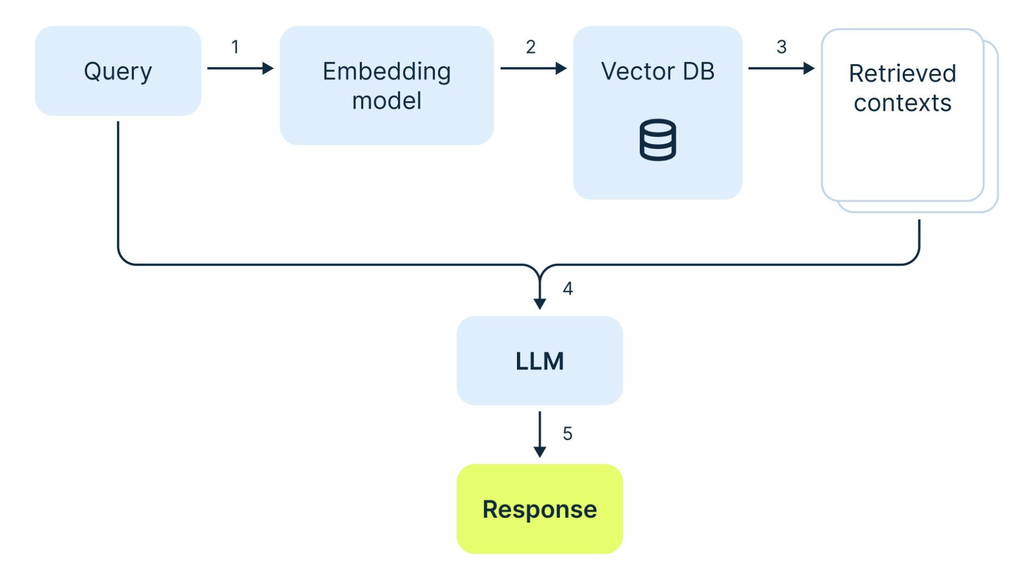
Retrieval-Augmented Generation (RAG) combines information retrieval with a Large Language Model (LLM) to generate context-aware answers.
Rather than relying entirely on the LLM’s pre-trained knowledge, RAG retrieves relevant information from an external knowledge source and uses it as context for generating the response.
How Traditional RAG Works
- User Query: A user submits a question through an application.
- Query Processing: The application sends the query to the retrieval service.
- Embedding and Search: The query is converted into an embedding and used to search a vector or hybrid index.
- Retrieve Context: The retriever returns the top-K relevant document chunks.
- Prompt Construction: A prompt builder combines the original question with retrieved context.
- LLM Processing: The LLM generates an answer using the supplied context.
- Response: The application returns the generated answer to the user.
Architectural Characteristics
- Predetermined retrieval workflow.
- Usually one retrieval cycle per query.
- Vector search or hybrid search.
- Predictable execution path.
- Lower orchestration complexity.
- Easier to monitor and optimize.
Key consideration: Traditional RAG depends heavily on retrieval quality. If the retriever returns incomplete or irrelevant context, the LLM may generate an incomplete or inaccurate answer.
Understanding Agentic RAG
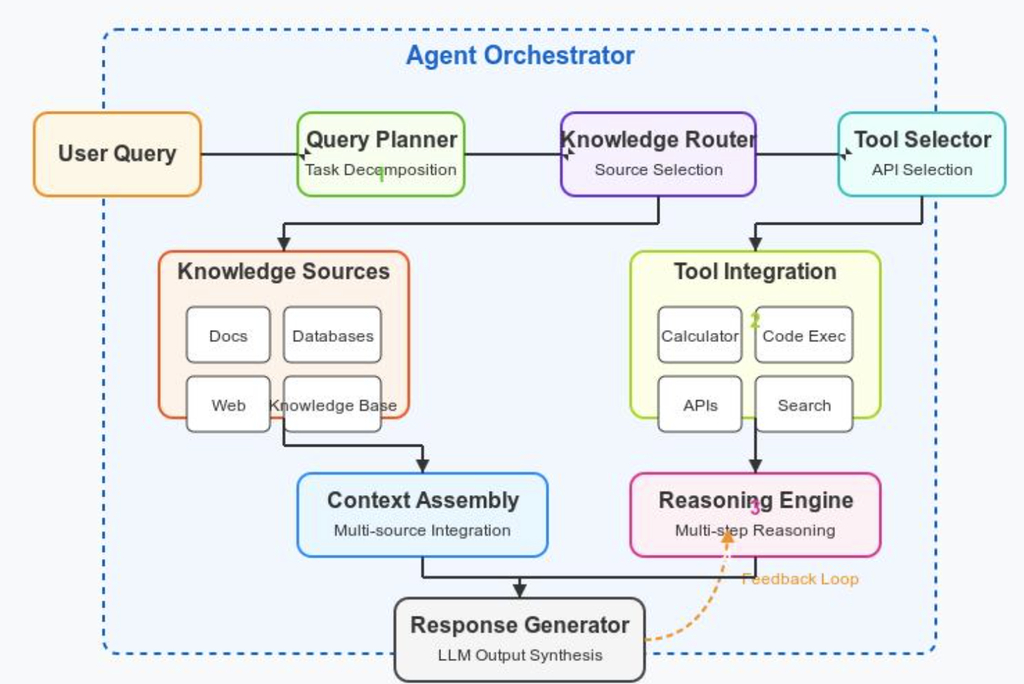
Agentic RAG extends traditional RAG by introducing an orchestration and decision-making layer.
Instead of following a fixed retrieval process, an agent can determine what information is required, select appropriate tools, retrieve evidence, evaluate the results, and refine its approach when necessary.
How Agentic RAG Works
- User Query: The user submits a question.
- Task Analysis: The agent orchestrator identifies the user’s intent and breaks down the task when needed.
- Tool Selection: The orchestrator selects appropriate tools, such as document search, vector databases, enterprise APIs, CRM, or web search.
- Evidence Retrieval: The selected tools retrieve relevant information.
- Evidence Evaluation: An evaluator checks whether the retrieved information is relevant, complete, and sufficient to answer the question.
- Iterative Retrieval: If evidence is insufficient, the agent can rewrite the query, select another source, or retrieve additional information.
- Context Construction: Once sufficient evidence is available, a context builder prepares the information for the LLM.
- Response Generation: The LLM generates the final response, ideally with supporting references.
Key consideration: Agentic RAG introduces flexibility, but also introduces additional execution time, infrastructure cost, operational complexity, and security considerations.
An agent should not continue searching indefinitely. Define explicit limits, such as a maximum of five retrieval iterations, an execution timeout, and a token budget.
RAG vs. Agentic RAG: Architectural comparison
| Architecture dimension | Traditional RAG | Agentic RAG |
|---|---|---|
| Workflow | Predefined | Dynamic |
| Retrieval | Usually one cycle | Multiple cycles when needed |
| Tool selection | Application-defined | Agent-driven within approved tools |
| Query refinement | Limited or predefined | Dynamic |
| Evidence evaluation | Basic relevance checks | Iterative sufficiency evaluation |
| Data sources | Usually predefined | Multiple sources |
| Latency | Lower | Potentially higher |
| Infrastructure cost | Lower | Potentially higher |
| Complexity | Low to medium | Medium to high |
| Governance | Relatively simple | Requires stronger controls |
| Best suited for | Knowledge retrieval | Complex information discovery |
| Predictability | Higher | Depends on orchestration |
Do We Really Need an AI Agent for Every Enterprise Use Case? Imagine an employee asks an enterprise AI assistant: What is our company’s parental leave policy? The application searches the HR knowledge base, retrieves the relevant policy, passes the content to an LLM, and generates an answer. Now imagine a different question: Am I…